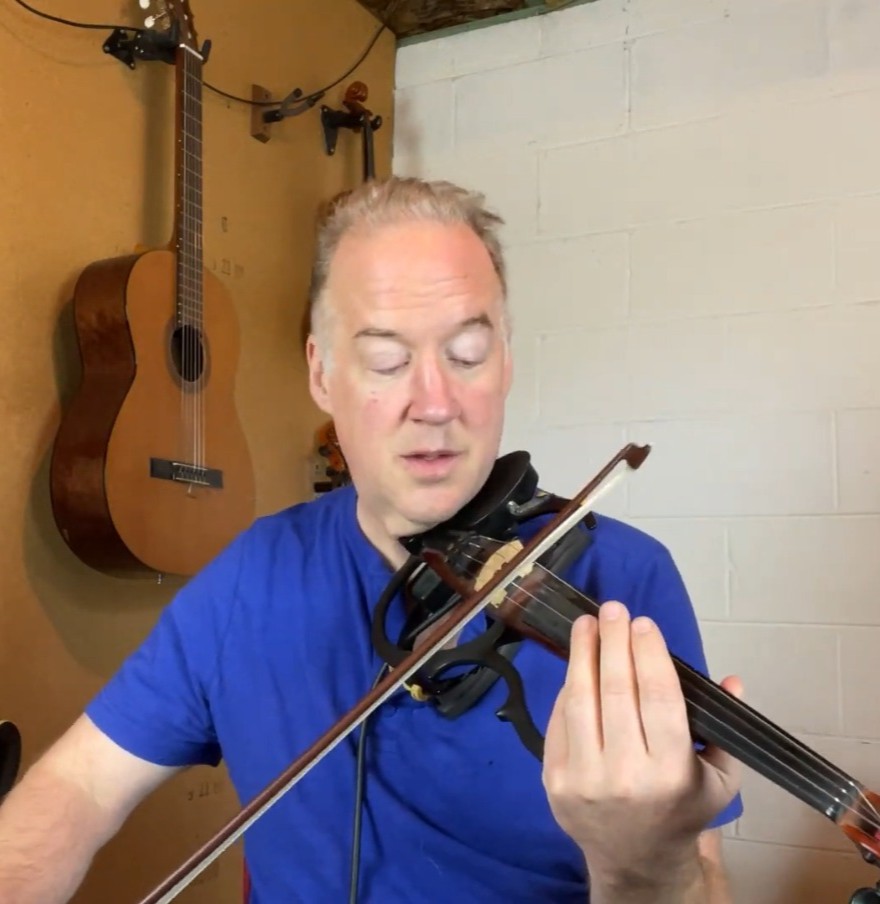
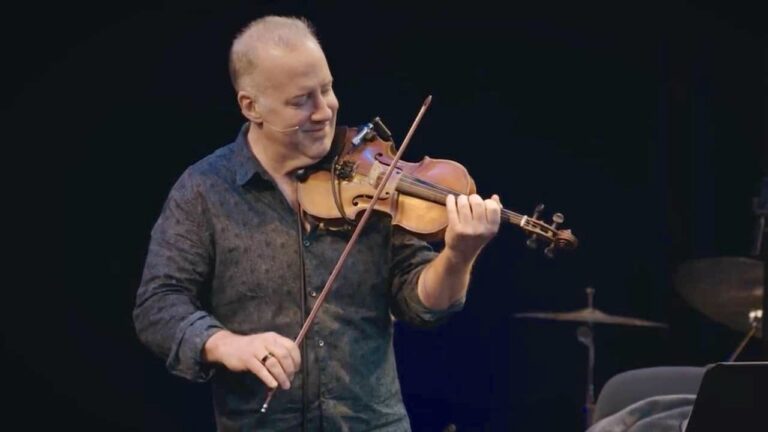
I was a classically trained violinist with a professional orchestra contract at 18 years old. At 20, I went to prison for four years.
It’s not the typical trajectory we talk about in the violin world. But I’m writing this for Violinist.com because that experience changed how I think about music education, and about what the violin can mean in the world. And I think it might matter to you, whether you are a teacher, a performer, or a student.
Let me back up.
I grew up in Columbus, Ohio, studying through the Suzuki method from age five. I went to the Chautauqua Performing Arts Institute the summer after eighth grade, and I remember the exact moment a 12-year-old violinist named Ruby played a solo with our orchestra with the soul of a 75-year-old woman.
Something stirred in me. I started practicing three hours a day. I knew exactly who I was. I felt whole.
By high school, I was also playing guitar and bass in rock bands, but the classical path was the one with structure. I got a scholarship to Ohio State, honors dorm, orchestra, the whole thing.
And then I turned my back on it. I found a different crowd, a different scene. I won’t belabor the details, but a series of choices led to a drug trafficking charge, and at age 20, I was sentenced to six to 25 years. I served four. And during that time, everything I thought I knew about music got taken apart and rebuilt.
Here is what I want to tell you, because this is really the heart of it.
The prison yard is a very interesting place. When I would go out into the yard, I would usually find the musicians. Some guys sitting at a picnic table, freestyling, keeping rhythm with their hands. Guys with acoustic guitars, maybe a harmonica, playing country music. Acapella gospel singers standing around the yard. I would listen. I would jam with them. And sometimes I would practice my Mendelssohn, Bach, or improvise by myself in the middle of the yard too.
I had been trained in one system of learning, one tradition, one set of values about what music was supposed to be. And there I was, surrounded by musicians whose depth and intelligence were undeniable, even though none of it came from the tradition I had been raised in.
I was learning something in this situation, and I felt like I owed it to myself and everyone around me to take it seriously. Not because I was trying to be open-minded in some abstract way. But because the music was real. The feeling was real. And besides, it was my only option if I wanted to make music with other people. It wasn’t like we had an orchestra.
I realized something then that has stayed with me for 30 years: The violin is an archetypal symbol in our culture. It stands for beauty, refinement, discipline, history, and excellence. All beautiful things. But it also tends to represent a very narrow slice of human experience.
Our music education system often treats the classical canon as the center, and other ways of learning as secondary. And I don’t say that to reject classical music. I love classical music.
But prison is where I confronted the limits of what I had been taught the violin could mean. I decided to study jazz and other forms of music. Not because I rejected classical music, but because I wanted the violin to mean something bigger than what I had been taught it could mean.
I have spent the last 30 years trying to understand what that experience taught me — about music, education, freedom, and living. That is part of why I made Redemption Time.
Redemption Time is a 70-minute multimedia performance film featuring me and the great poet Jimmy Santiago Baca, who also went to prison as a young man and taught himself to read and write while incarcerated. He now has a PhD in Literature and won the American Book Award for Poetry.
The film was directed by David Gonzalez, whose work has been featured at Lincoln Center, on PBS, and on NPR.
It features an incredible band of musicians, including Shannon Hoover (bass), Lovell Bradford (piano), and Grammy-award-winning multi-instrumentalist Hamilton Hardin (drums and saxophone).
The hour-long film unfolds across 10 episodes, moving through distinct themes: innocence, the fall, complicity, guilt, violence, the code, hurt, thirst, freedom, and love. Each episode interweaves poetry, music, imagery, and first-person storytelling.
The violin is not background music in the film. It becomes another voice.

Now, I know what some of you might be thinking that this sounds heavy. This sounds like it is about prison. Why would I want to watch this? Fair question.
Yes, there are hard stories in the film. There is pain and honesty about what incarceration does to a human being. But that is not the reason to watch it. The reason to watch it is that this film is about what happens when people are given a chance to begin again. It is about what happens when art meets the worst circumstances a person can face, and still finds a way through. And I think that is something every musician understands, even if your circumstances are nothing like mine.
If you are a teacher, this film may make you think differently about what you are really offering when you hand a young person a violin. It is not just technique and repertoire. It can be a tool for survival, expression, discipline, identity, and connection. If you care about where music education is headed, the film raises questions about whose stories get told, whose traditions get valued, and what happens when we create space for more of it.
The violin does not have to be an instrument of one tradition. It can be a bridge.
After showing this film in jails, churches, music venues, theaters, and universities, one of the most powerful moments I witnessed was a young cellist breaking down after a screening because her father had been locked up for years. She had shut him out. After the movie, she said she was going to call him that week.
That is what this film does at its best: it opens something. If you are a performer, I think you will respond to the music in this film, and hear how the violin can exist in different spaces. If you are a teacher, I think you may hear your own students differently. And if you have ever made a mistake, felt like an outsider, or wondered whether redemption is real, this film is for you too.
I’m still a work in progress. I’m still learning how to be honest about my story without letting it define me, how to rewrite that story when needed, and how to share it in a way that creates space for other people to reflect on their own.
On June 16, you can see Redemption Time from wherever you are. There will be two livestream showtimes, 2 p.m. Eastern and 8 p.m. Eastern, followed by a live online Q&A. Choose your screening and get tickets here.
I would love for you to experience it and consider bringing the film to your community or institution (https://redemptiontimeshow.com/host-event/ ), where it can be paired with discussion and learning.

The artists in ‘Redemption Time’: Lovell Bradford, >Jimmy Santiago Baca, Shannon Hoover, Christian Howes and Hamilton Hardin.
I will leave you with these words from Jimmy Santiago Baca: “They can build these prison walls higher and skirt them on top with bladed wire, but the razor wire cannot entangle my ideas and keep them from flying over.”
That is what art can do — that is what the violin can do.
Blog Posted on Violinist.com