How do you hold a violin bow? A useful starting point is a gently bent thumb near the frog, middle fingers draped over the stick, a relaxed index finger and a curved pinky resting on top. The aim is a hand that can balance and guide the bow while remaining able to move.
If you are learning your first violin bow hold, start with the setup below. If you already play but your fingers straighten or your hold slips during a tune, the same reset and exercises can help you work on that specific problem.
Watch: How to Fix Your Violin Bow Hold
In this free lesson from Creative Strings Academy, I work with Deb, a member of our coaching community, on setting up her bow hold, keeping the pinky curved and using a small windshield-wiper exercise. You can watch without signing up.
Watch the bow-hold lesson on YouTube.
Table of Contents
How to Hold a Violin Bow, Step by Step
- Support the bow with your left hand. Let that hand carry its weight while you arrange your right hand. You do not need to balance everything at once.
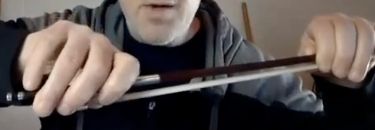
- Shake out your right hand. Let the fingers soften, then bring the hand to the bow. In the lesson, we start by letting the fingers flop into place rather than forcing a stiff shape.
- Set the thumb and middle fingers. Keep the thumb gently bent near the point where the frog meets the stick. Let the middle and ring fingers drape around the stick and frog.
- Place the pinky on top of the stick. Begin with a curved finger and contact through its tip. In Deb’s lesson, noticing when that finger straightens is an important part of the work.
- Check the whole hand. Let the index finger rest on the stick without reaching or squeezing. Keep the thumb and pinky able to bend. Use the video to compare the shape and movement, rather than trying to copy a frozen pose.
Hand sizes and teaching traditions differ. These are starting points for the setup demonstrated here, not a requirement that every player’s fingers look identical.
Two Bow Hold Exercises to Try
1. Take the hand off and reset
Support the bow with your left hand. Remove your right hand, shake it out and rebuild the hold: fingers drape, thumb bends, pinky curves. Repeat slowly. This gives you a way to return to a familiar setup when the hold starts to change.
2. Try the small windshield-wiper movement
In the lesson, the curved pinky helps move the bow up and down in a small balancing motion. Watch the demonstration from about 2:29 before trying it. Keep the thumb and pinky bent, use a small movement and keep the left hand ready to support the bow.
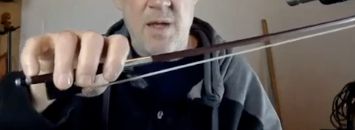
If the pinky straightens or the rest of the hand begins squeezing, pause and reset. A few controlled repetitions are a better starting point than continuing after the shape has fallen apart.
Put the Bow on the String
Once the setup feels more familiar, try a few long bows and then shorter strokes on an open string. Notice whether the hold stays comfortable as you move. This is the next step we try in the video: bringing the exercise back to actual playing.
Work on one thing at a time. Record a short close-up of your hand setting up the hold and drawing the bow. That gives you something specific to review with your teacher or practice community.
Common Violin Bow Hold Questions
Where should my thumb go?
For the setup shown here, the thumb is gently bent near the meeting point of the frog and stick. Support the bow with your other hand while you find that position.
What if my pinky keeps straightening?
Return to the supported setup and try a smaller movement. Deb encounters this in the lesson, so you can see the adjustment happen in a real teaching exchange.
Is this only for beginners?
No. The setup is useful when you are learning how to hold the bow, and the reset can also help an experienced player whose hold changes during playing. Classical violinists and fiddlers can both explore these fundamentals.
Continue With Free Bowing Lessons
- Bowing exercises: bow control, tone, string crossings and shuffle patterns
- Get a better violin sound and reduce bowing noise
- Browse the free play-along lesson library
Want feedback and guided practice? Explore Creative Strings Academy, our paid coaching and practice community.