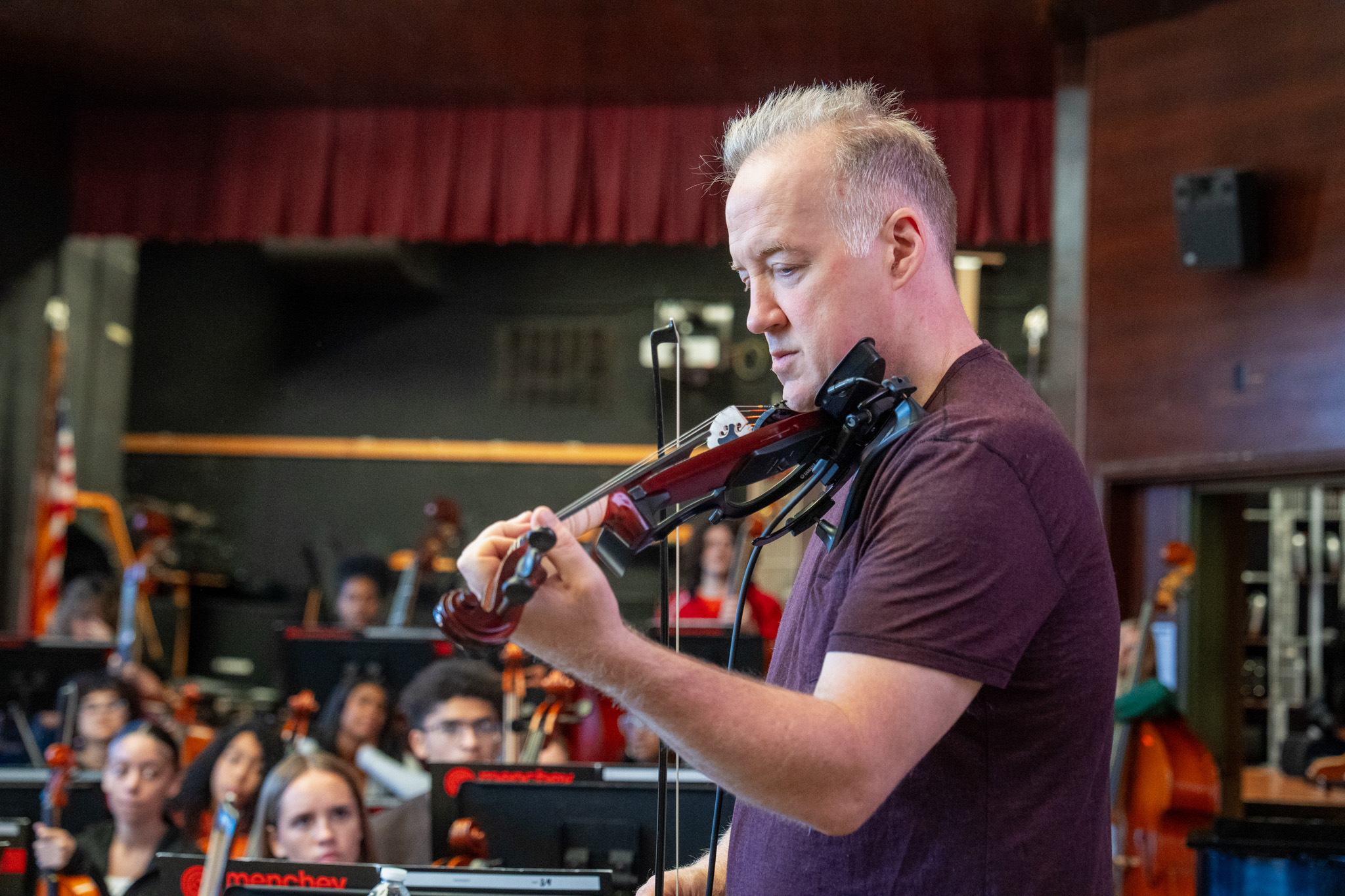

By changing your practice warm up, you’ll be able to get better faster.
Think about it: What do you accomplish during those 20 minutes besides working on technique?
You can do a lot more during those 20 minutes, while still developing your technique.
My intuitive routine will save time while enabling you to:
Table of Contents
- internalize harmony
- master fingerboard geography
- gain comfort with improvisation and other genres of music
If not, I’ll publish a video of myself playing Devil Went Down to Georgia in my underwear on a snowy day.
Watch the free video below for a demonstration of some of the exercises. Then explore the current Jazz Scales eBook for violin, viola, and cello.
Explore the current Jazz Scales eBook for violin, viola, and cello.
Browse current books, courses, sheet music, and play-along resources in the Christian Howes Shop.
Takeaways from the book:
- Visualize all key signatures across the instrument in any position
- Combine right & left arm technique with improvisation
- Save time while developing technical & harmonic freedom
- More intuitive, fun, and creative approach to practice
- Apply to any genre including folk, R&B, Rock, Jazz, Latin, & more
- Gain the ability to improvise over chord progressions with greater ease and speed
Excerpt: Play voice led “scale pairs” (A pattern alternating between two scales. For example: Play one bar of a pattern in G melodic minor followed by one bar of D altered) 
- Get my full recommended list of chord pairs in the book and part 2 of the video series.
- Continue with Step 6 and beyond.
If you’ve “been meaning” to go beyond your classical training…
Sometimes the best way to improve is to realize you want more.
If you don’t decide to take action and make a change then how can you expect things to improve?
The scary thing is that scenario is more realistic than you may realize.
Just think, how long have you wanted to make a change?
“If you keep doing what you’ve been doing for the past year, 2 years, or 5 years and nothing has changed…then how can you expect the next few years to be any different.”
So do something about it. Take control.
Don’t get stuck in your current patterns. Take action.
Most people view paying for a solution as a cost, yet they rarely realize there is also a cost to doing nothing.
But you’re not most people. You’re willing to grow and improve. Act on it.
View the current Jazz Scales eBook details and purchase options.
100% Guarantee
If you are not 100% satisfied with your purchase, you can return the product and get a full refund or exchange the product for another one of same price.
You can return a product for up to 30 days from the date you purchased it.
Check out the companion books (and courses):
Arpeggios for Jazz Violin, Viola, and Cello
and many more…
Contact us
If you have any questions, please contact us: chris@christianhowes.com